Dear Readers,
In this edition of our monthly newsletter, we will delve into the development of Karl Lagerfeld Residences Lisboa – one of our most recently launched projects and a defining encounter between fashion, architecture, and place.
Guiding us through this creative journey is the team behind its design: Andrea Boschetti, Head of Design, who personally envisioned the building’s singular façade; Senior Architects Ana Lazovic and Carlo Alberto di Carlo; Architect Angelika Andrejewska; and Marta Minciotti; and Junior Architect Madi Zholdasbekov, who led the interiors. Together, they have shaped a project where precision, narrative, and context converge.
What inspired the façade design of Karl Lagerfeld Residences Lisboa, and in what ways did the existing structure, the brand’s distinctive identity, and the surrounding context shape its final architectural language?
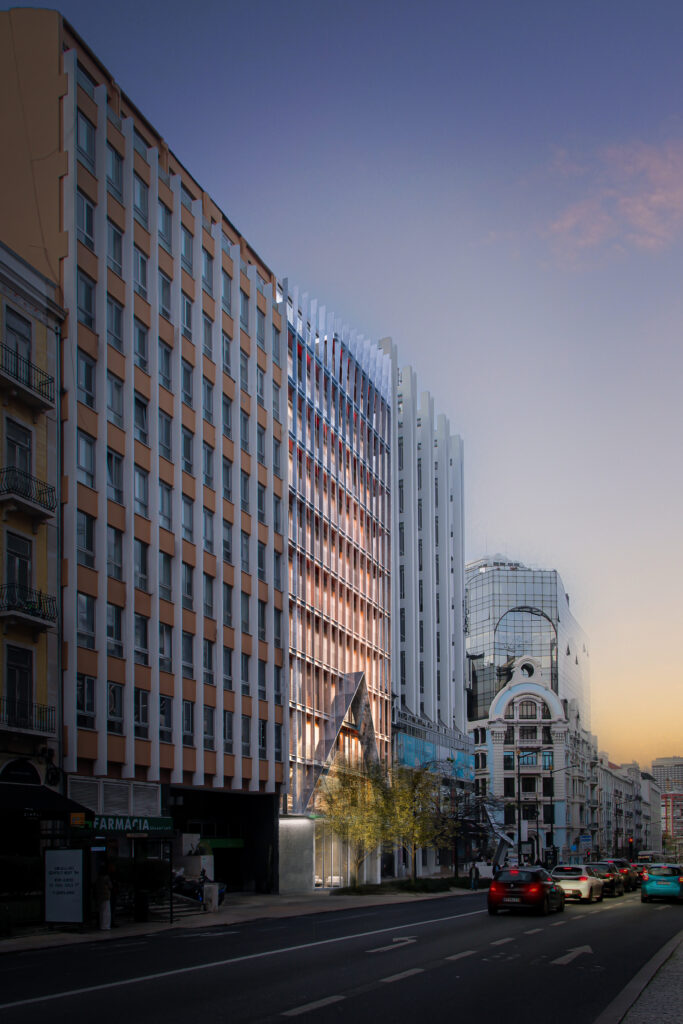
The façade of Karl Lagerfeld Residences Lisboa is conceived as an encounter between Lisbon and the unmistakable vision of Karl Lagerfeld. It is a building shaped by constraint, refined by context, and elevated by brand narrative.
The site came with clear limitations. Strict height regulations restricted vertical expansion, and the neighboring protected building by architect Conceição Silva required a respectful and measured response. Our design direction opted for precision and articulation, allowing the façade to express identity through detail, proportion, and refinement.
The architectural language of the project is shaped by two defining forces: the spirit of Lisbon and the distinctive universe of Karl Lagerfeld.
Lisbon provided the cultural and architectural foundation for the project. The city’s luminous whites, its disciplined street geometry, and the continuity of façades along Rua Braamcamp established a framework of proportion and rhythm. The tradition of azulejos and glazed ceramics offered a material reference deeply rooted in Portuguese identity.
Lagerfeld’s fascination with perception, graphic clarity, and optical illusion — notably reflected in his admiration for. Escher — inspired an approach where architecture would reveal more than it initially appears to show. The idea that a surface can contain hidden depth became central to the façade’s narrative.
The result is a façade that respects Lisbon’s urban rhythm while subtly disrupting it.
From a frontal view, the composition aligns with the street’s regular geometry, maintaining harmony with its surroundings. Yet as one moves along the pavement, the building transforms. A system of aluminum and glass blades introduces a kinetic dimension, capturing and refracting Lisbon’s changing light. The façade shifts with perspective, creating a dynamic experience.
A defining architectural gesture anchors the elevation: an inverted V-shaped canopy resolving into a triangular form — a subtle geometric signature associated with Lagerfeld’s visual language. Leaning pilasters frame the façade and gradually thicken toward the center. As one approaches, this calibrated variation produces a sense of expansion, almost as if the building inflates. What appears restrained from afar becomes expressive in movement.
Portuguese ceramics are reinterpreted in an unexpected way. Installed beneath the balconies, they transition from white to a deep red associated with the brand. Depending on the observer’s position, the façade reveals different intensities of color. When viewed from directly beneath the entrance, the building becomes fully immersed in red, creating a striking perspective effect that draws the gaze upward.
Sustainability is embedded within this architectural language. The balustrades integrate photovoltaic technology, allowing the building to produce its own energy. Solar panels are not added elements; they are the balustrades themselves so that performance and design operate as one unified system.
At night, concealed lighting positioned behind the pilasters casts vertical rays across the façade, transforming it into a composition of light and shadow — a refined, abstract expression that continues the dialogue between illusion and clarity.
How did you translate Karl Lagerfeld’s legacy into Lisbon’s cultural context, and what was the core thematic principle guiding the interior design?
Balancing the legacy of Karl Lagerfeld with Lisbon’s character required translating the brand’s ethos into a site-specific language. The design embraces clarity, intellectual rigor, and discipline — values long associated with Karl Lagerfeld’s persona — while grounding them in Lisbon’s genius loci. Rather than relying on literal references or decorative motifs, the interiors reflect his attitude: precision, refinement, and a measured engagement with contemporary art, design, and architecture.
Light plays a central, structural role. South-facing living areas open onto sweeping 180-degree views, integrating the city into daily life, while windowless spaces, such as the spa, transform constraint into atmosphere through carefully diffused illumination that evokes natural light. Throughout, light is used to shape spatial perception as much as materials and proportion do, connecting the interiors to Lisbon’s sunlit essence.
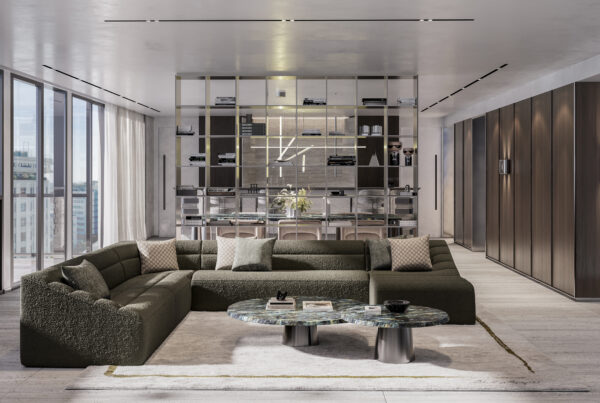
Material selection expresses a deliberate dualism. Hard, architectural surfaces — black Via Láctea marble, brushed steel, concrete, and mirrored elements — convey discipline and graphic clarity, while grigio woods and warm timber soften the mineral presence, introducing tactility and domesticity. Travertine, glazed ceramic tiles, and micro-cement subtly reference Lisbon’s architectural heritage, whereas sculptural steel features and circular mirrors — reminiscent of a camera lens — introduce contemporary sharpness aligned with Karl Lagerfeld’s visual vocabulary. Surfaces remain controlled, contrasts intentional, and each element positioned within a clear hierarchy.
Dualism here becomes emotional: precision tempered by comfort, assertiveness softened by tactility. From the sculptural steel-and-mirror bookshelf to mirrored-tile jacuzzis and warm timber finishes, every detail is calibrated to produce a residence that is both disciplined and lived-in, rigorous yet inviting.
In this way, the interiors embody Karl Lagerfeld’s legacy, creating a Lisbon home grounded in local context and enriched by European refinement.
In what ways does this project redefine the idea of “luxury living” through a fashion-influenced lens?
Luxury is reframed as atmosphere, proportion, and curated experience.
Much like couture, where construction and silhouette prevail over embellishment, luxury here is expressed through precision and restraint. Sculptural gestures coexist with clean lines; materials speak through texture.
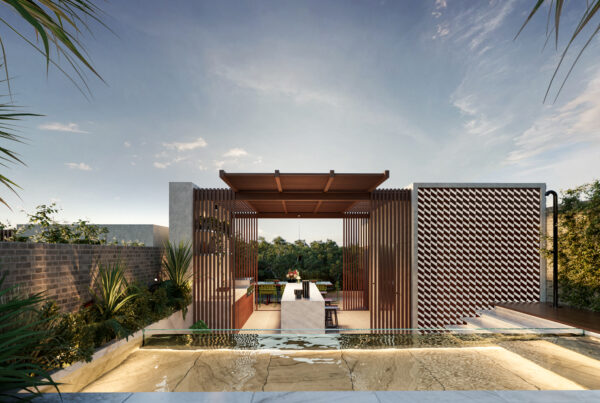
Amenities elevate everyday rituals: a rooftop pool overlooking Lisbon, a private travertine garden, mirrored-tile jacuzzis, and a double pool lined in mother-of-pearl mosaic. These elements transform function into experience. Luxury becomes sensorial and intellectual: a lifestyle shaped by clarity and thoughtful layering.
Were there any interior design challenges unique to this project?
The primary challenge was connecting two strong identities with clearly defined languages — the Karl Lagerfeld ethos and Lisbon’s architectural character.
The project had to assert a distinct identity without overwhelming its setting; to use powerful materials without sacrificing warmth; to embrace minimalism without creating coldness. This required precise calibration — of proportion, of light, of hierarchy.
Additionally, environmental performance was a defining factor in the façade’s conception, ensuring environmental responsibility was integrated into the architectural envelope while interiors favored material longevity and timeless design choices.
Ultimately, the challenge became the project’s strength: translating brand, place, and lifestyle into an architectural expression that feels measured, contemporary, and deeply contextual.
Thank you for joining us behind the scenes at Karl Lagerfeld Residences Lisboa. We hope you enjoyed discovering how legacy and design converge to create a residence that is both a tribute to legacy and a celebration of Lisbon’s unique spirit.